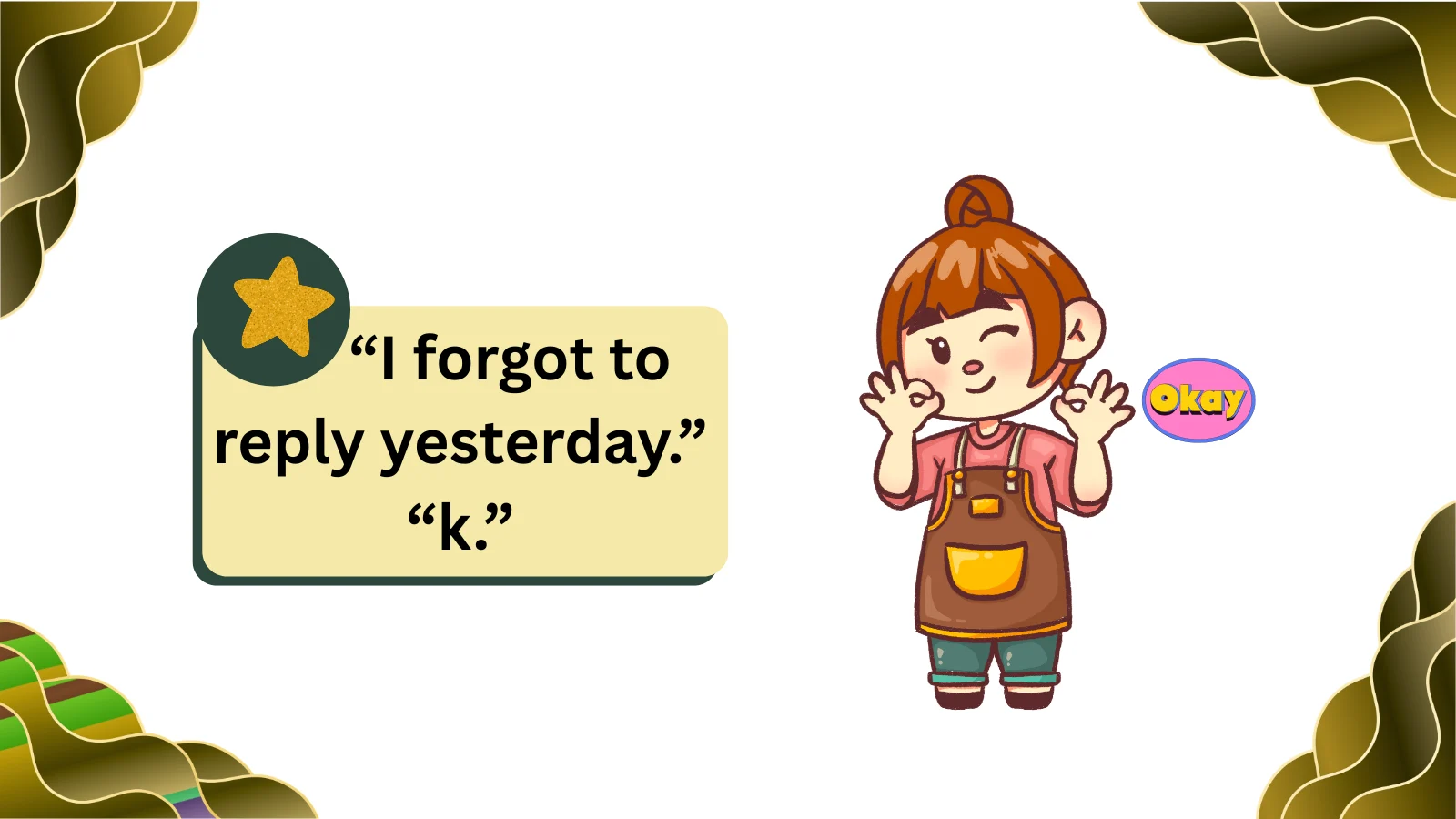
If you’ve ever sent a long message and received a dry “k” in response, you’re not alone and you probably paused to wonder what does k mean in text.
In modern texting slang, especially across social media, chats, and DMs, “k” has taken on meanings far beyond its literal definition.
This guide breaks down the meaning of “k” in chat, how it’s used as internet slang, the tone it carries, and why it can feel polite, passive aggressive, or cold depending on context.
What Does K Mean in Chat?
In chat and texting slang, “k” is a shortened form of “okay” used to acknowledge a message, signal agreement, or end a conversation. In digital communication, it often carries emotional subtext ranging from neutral acceptance to boredom, annoyance, sarcasm, or emotional distance depending on context and tone.
Literal Meaning of K
Literally, “k” is the abbreviated letter form of “okay.”
The word “okay” originated in the 19th century as a humorous abbreviation, and over time it evolved into one of the most common expressions in English. In texting, “k” represents an ultra-shortened version used for speed, minimal effort, or emotional shorthand rather than full verbal clarity.
How Is K Used as Slang Online?
As internet slang, “k” is less about the word and more about the vibe. In Gen Z and Gen Alpha digital culture, shortening words often signals emotional tone rather than laziness. On platforms like TikTok, Discord, Instagram, Snapchat, and WhatsApp, “k” can imply:
- Emotional detachment
- Passive resistance
- Dry acknowledgment
- Sarcastic compliance
- Conversation shutdown
Unlike “ok” or “okay,” “k” is often interpreted as intentionally blunt. In meme culture, it’s frequently used ironically to exaggerate disinterest. As a social media expression, it’s a powerful emotional slang term because it says very little—but implies a lot.
Is K Commonly Used in Texting?
Yes, “k” is extremely common in texting, but its popularity depends on age group and platform. Gen Z uses it frequently but very deliberately. Millennials may see it as rude or dismissive, while older users may interpret it as neutral. It appears most often in casual chats, private DMs, gaming chats, and comment replies rather than formal digital communication.
Examples of K in Text Messages
Here are realistic, modern examples showing how “k” is used in text messages and online conversations:
Example (Neutral):
A: “I’ll be there in 10.”
B: “k”
Example (Annoyed):
A: “I forgot to reply yesterday.”
B: “k.”
Example (Passive-Aggressive):
A: “I think we should talk later.”
B: “k”
Example (Conversation Ender):
A: “Did you want to hang out?”
B: “k”
Example (Sarcastic):
A: “I’m definitely not late this time.”
B: “k lol”
Example (Group Chat):
“Meeting moved to tomorrow.”
Reply: “k”
Example (Social Media Caption):
“When they say ‘we’ll see’ so you just reply with k.”
Similar Slang Words or Expressions
Several texting slang terms carry a similar emotional function to “k,” including:
- Ok – More neutral, less sharp
- Sure – Polite but sometimes skeptical
- Fine – Emotionally loaded, context-heavy
- Bet – Agreement with confidence or irony
- Aight – Casual acceptance
- Cool – Neutral or disengaged approval
Each variation shifts tone subtly, which is why “k” stands out as the most minimal and potentially loaded option.
K vs Similar Terms (Comparison Section)
K vs Ok
“Ok” feels neutral and polite, while “k” often feels colder or emotionally distant.
K vs Okay
“Okay” suggests engagement or sincerity. “K” suggests closure or detachment.
K vs Sure
“Sure” implies willingness; “k” implies acknowledgment without enthusiasm.
Is It Formal or Informal?
“K” is strictly informal.
- Casual texting: Common
- Social media: Common
- Professional communication: Not appropriate
- Academic writing: Never used
Using “k” in emails, work chats, or professional messages may be interpreted as dismissive or rude due to its abrupt tone.
K Meaning in Numbers
- In numbers, K stands for thousand.
- The letter comes from the Greek word “kilo,” meaning one thousand.
- For example, 1K = 1,000.
- Similarly, 10K = 10,000.
- On social media, follower counts often use K as a shortcut.
- A profile with 25K followers has 25,000 followers.
- Businesses also use K in reports and statistics.
- It makes large numbers easier to read.
- The symbol is commonly used worldwide.
- Today, K is one of the most recognized abbreviations for thousand.
K Meaning in Love
- In love-related texts, K can have different meanings depending on the situation.
- It is usually a short form of “Okay.”
- Sometimes it signals that a person is busy.
- A simple “K” may appear cold or uninterested.
- Many people view it as less friendly than “Okay” or “OK.”
- In relationships, context is very important.
- A happy conversation ending with “K” may be harmless.
- During an argument, it can sound dismissive.
- Some partners use it when they are upset.
- Understanding the sender’s tone helps reveal the true meaning.
K Meaning in Social Media
- On social media, K often means thousand.
- It is commonly used for followers, likes, and views.
- For example, 5K likes means 5,000 likes.
- Users prefer K because it saves space.
- The abbreviation appears on platforms like TikTok, Instagram, and Facebook.
- K can also mean “Okay” in comments or direct messages.
- Some users type only “K” as a quick response.
- The meaning depends on where it is used.
- In statistics, it usually refers to a thousand.
- In conversations, it often means agreement or acknowledgment.
What Does K Mean in Hood Slang TikTok?
- In hood slang on TikTok, K can have several meanings.
- It is sometimes used to show opposition toward a group or gang.
- The term often appears in specific regional slang.
- Its meaning can vary depending on the community using it.
- Some creators use K as part of usernames or hashtags.
- In certain contexts, it may represent disrespect toward rivals.
- Slang meanings change quickly on TikTok.
- Not every use of K has a negative meaning.
- Many users simply use it as shorthand for “Okay.”
- Always consider the context before interpreting hood slang terms.
K Meaning in Money
- In money-related conversations, K means one thousand dollars or units of currency.
- For example, $1K equals $1,000.
- Likewise, $50K means $50,000.
- The abbreviation is common in salaries and budgets.
- Businesses often use K in financial reports.
- It helps simplify large amounts of money.
- Job listings may advertise a salary as 60K per year.
- Investors and entrepreneurs frequently use the term.
- K can apply to many currencies, not just dollars.
- It remains one of the most popular financial abbreviations worldwide.
Frequently Asked Questions
Is k Gen Z slang?
Yes. While “k” existed before Gen Z, modern Gen Z texting culture uses it deliberately as emotional shorthand. It often signals tone more than agreement, making it a key piece of Gen Z digital communication and internet slang.
Is k trending on TikTok?
“K” appears frequently in TikTok comments and memes, often used sarcastically or ironically. While not a trend by itself, it’s part of ongoing meme language that exaggerates emotional minimalism and passive responses.
Can k refer to a person?
No. “K” does not refer to a person in slang usage. It strictly functions as a response or acknowledgment in text messages and online communication.
Is k sarcastic?
It can be. Sarcasm depends entirely on context. When used after emotional or long messages, “k” is often read as sarcastic or dismissive rather than neutral.
Is k offensive?
Not inherently. However, it can feel rude or disrespectful depending on the situation. In emotionally sensitive conversations, “k” may come across as cold or uncaring.
Is k commonly used in texting?
Yes. It’s widely used across messaging apps, especially in casual or fast-paced conversations. Its meaning shifts based on tone, timing, and relationship between speakers.
Does k mean someone is mad?
Sometimes. While not a guaranteed sign, “k” can indicate annoyance, emotional withdrawal, or passive frustration—especially when replacing a more expressive response.
Quick Summary
- “K” means “okay” in texting slang
- It’s an informal internet expression
- Tone ranges from neutral to dismissive
- Common in Gen Z and social media culture
- Often implies emotional distance or conversation closure
One-sentence definition:
In chat and texting slang, “k” is a shortened form of “okay” used to acknowledge a message, often carrying emotional subtext like indifference, sarcasm, or detachment depending on context.
Final Thoughts
Understanding what does k mean in text isn’t about the letter it’s about reading the room.
In modern digital communication, minimal replies speak loudly.
Whether neutral or emotionally loaded, “k” has become one of the most powerful tiny responses in internet slang, proving that sometimes one letter is all it takes to change the entire tone of a conversation.
Leave a Reply